Our history

St John’s is among the oldest Durham colleges, founded in 1909 as a theological college for the training of Anglican clergy.
Although the College began with just £2 in capital, support grew quickly, and by 1912 it occupied several houses on the South Bailey, where the College Reception remains today. In 1919 we became a full constituent college of the University, expanding and flourishing over the following decades.
In 1958, Cranmer Hall was established as a distinct but integral part of the College to train ministers for ordination, while members of John’s Hall studied for Durham University degrees in all disciplines, as they do today.
In 1966, St John’s became the first Church of England theological college to train men and women together. This commitment to equality continued, and in 1973 John’s became the first college in the University to become co-educational. Our first female Principal, Ruth Etchells, was appointed in 1978.
Our home in the heart of Durham’s historic peninsula reflects our ethos of honouring tradition while shaping the future. The College estate combines listed historic buildings and purpose-built modern facilities – from converted Georgian townhouses once home to the Bowes family, ancestors of the present King and founders of the Bowes Museum, to the 12th-century Chapel of St Mary the Less. Our Learning and Resource Centre and College Library, opened in 2018, embody this same spirit, offering beautiful modern spaces for study, teaching, and community life.

John's Through The Decades
Foundation of St John’s College as a theological college for the training of Anglican clergy.
1909

Construction of Cruddas, the College’s first purpose-built student accommodation
1913

1919

St John’s becomes a full constituent college of Durham University
Lorem ipsum dolor sit amet, consectetur adipiscing elit, sed do eiusmod tempor incididunt ut.
Student numbers reach 100 (83 ordinands and 17 in other fields)
1954

Establishment of Cranmer Hall as a distinct part of the College
1958

1966

Women admitted to Cranmer Hall, the first Church of England theological college to train men and women together
St John’s becomes co-educational and establishes the Senior Common Room
1973

The Cellar Bar opens
1976

Ruth Etchells appointed as the first female Principal
1978

Lorem ipsum dolor sit amet, consectetur adipiscing elit, sed do eiusmod tempor incididunt ut.
1981

Regular contracts help to launch the College’s summer conference trade
Leech Hall opened by the Queen Mother
1987

Lorem ipsum dolor sit amet, consectetur adipiscing elit, sed do eiusmod tempor incididunt ut.
The Garth student accommodation, with accessible features, is built
2010

2018

The Learning and Resource Centre, including the Sir William Leech Library, opens
The David Wilkinson First Generation Scholars Fund launched
2023


Did you know?
Our College mascot, Olav the Alligator, was named after King Olav V of Norway, who visited John’s in the 1960s. The original Olav was proudly paraded outside Palace Green to mark the royal occasion, and the name has stuck ever since.
A history of our leadership
Explore the individuals who have shaped our community’s direction.
Principals of
St John's College
- 1909 – 1911 Sidney Nowell Rostron
- 1911 – 1919 Dawson Dawson-Walker
- 1919 – 1945 Charles Steel Wallis
- 1945 – 1953 Ronald Williams
- 1954 – 1955 G.J. Cumming (acting)
- 1954 – 1969 Jim P. Hickinbotham
- 1970 – 1978 John C. P. Cockerton
- 1978 – 1988 Ruth Etchells
- 1988 – 1992 Anthony Thiselton
- 1992 – 1999 David V. Day
- 1999 – 2006 Stephen Sykes
- 2006 – 2023 David Wilkinson
- 2023 – present Jolyon Mitchell
Wardens of
Cranmer Hall
- 1968 – 1970: John C.P. Cockerton
- 1971 – 1979: Tim Yeats
- 1979 – 1983: Christopher Byworth
- 1983 – 1992: Ian Cundy
- 1993 – 1996: John Pritchard
- 1996 – 2004: Steven Croft
- 2005 – 2011: Anne Dyer
- 2011 – 2016: Mark Tanner
- 2017 – 2023: Philip Plyming
- 2023 – present: Nicholas Moore
John’s Chronicles
3 November 2025
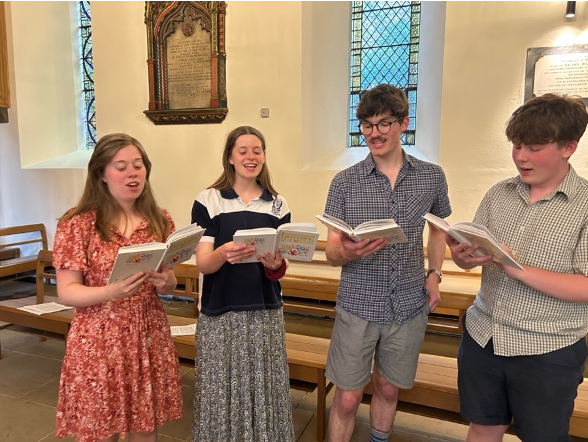
JMS Choir: A Welcoming Musical Opportunity
Olivia Chatterley describes her time co-leading the JMS choir last year and encourages anyone to join the welcoming community. I have absolutely loved co-leading the JMS Choir this year and enjoyed the opportunities to perform. We had the privilege of singing at John’s formals, a nativity production, a memorial, a college BBQ and even in the […]

28 October 2025
Returning Home to St John’s
Dan Bavister, Frep, Captain of the Badminton Team, and last year’s John’s Chronicle Editor-in-Chief, describes the community he has found in John’s as he arrives in Durham, ahead of beginning his master’s in English Literature. As September rolls around, it brings with it, in Durham at least, a whirlwind of activity. Here at John’s, it […]

24 September 2025
Reflections 40 Years On
After attending the 40 Years on Reunion this September, Richard Horton (1983-1986 Natural Sciences) shares his reflections on returning to John’s and the value of kindness. Richard in 1985 It’s 39 years since I left Johns. I came back a lot over the next year or two, so I know people who started after I […]